§ 1 — Overview
What tech UGC actually is in 2026
Tech UGC (tech user-generated content) is short-form, creator-made video for software, SaaS, AI tools, and mobile-app brands. In 2026 it splits into two models: high-volume ambassador-account content (80–300 videos/month at $10–$20 base + view bonuses) and one-off whitelabel ads ($200–$1,500 per video). Top tech UGC creators earn $3K–$15K+/month.
| Quick fact | Answer |
|---|---|
| What is tech UGC? | Short-form creator video for software, SaaS, AI and app brands |
| Who pays for it? | SaaS, mobile-app, AI-tool, fintech and B2B software brands |
| Typical tech UGC rates | $10–$20/video (high-volume) · $200–$1,500/video (one-off) |
| Monthly earnings | $3K–$15K+/mo for active tech UGC creators |
Tech UGC is short-form, creator-made video for software, SaaS, AI tools and app brands. It looks organic, but it's engineered to drive installs, signups and trials. People also call it tech user-generated content, UGC for tech companies, or SaaS UGC — same thing.
The category has split into two very different jobs. The legacy job — sell a polished one-off video to a paid-ads team — still exists. But in 2026 the center of gravity has moved to high-volume content: a tech UGC creator (or a small studio) ships dozens of short videos per week to a newly created ambassador account on TikTok or Reels, set up exclusively for that brand, and gets paid in volume + view-based performance bonuses rather than premium per-video rates.
This is the model behind almost every viral mobile-app and consumer-AI account you've scrolled past in the last twelve months — Cal AI, RIZZ, Rocket Money, dozens of YC-backed startups. Brands fund it because a single hook that clears a million views pays back the entire month of content. Creators like it because consistent output, not luck or follower count, is the lever they actually control — which is why how to become a tech UGC creator in 2026 looks very different than it did two years ago.
The four formats you'll see
- High-volume ambassador-account content. Dozens of short videos per week posted directly to a newly created ambassador account on TikTok or Reels. The dominant model in 2026 for mobile apps and consumer AI.
- Performance-bonus shorts. Sub-15-second clips engineered to clear view thresholds (10K, 100K, 1M). Bonuses often dwarf the per-video base fee.
- Screen recordings & demos. Voice-over walk-throughs of a product feature. Reused across paid social and the brand's organic feed.
- One-off whitelabel ads. The legacy model: a finished video sold to a brand's paid-ads team. Still alive in B2B SaaS, but no longer where the money is for most creators.
§ 2 — The two models
High-volume is the main model. One-off is the legacy.
Both models share the name "tech UGC," but they're very different jobs. In 2026, the high-volume / dedicated-account model is where the bulk of tech UGC creator income now lives — it scales with output and view performance instead of capping at a per-video rate. The one-off whitelabel model still exists for B2B SaaS, but it's the smaller, slower sibling. See current tech UGC rates and real tech UGC examples below.
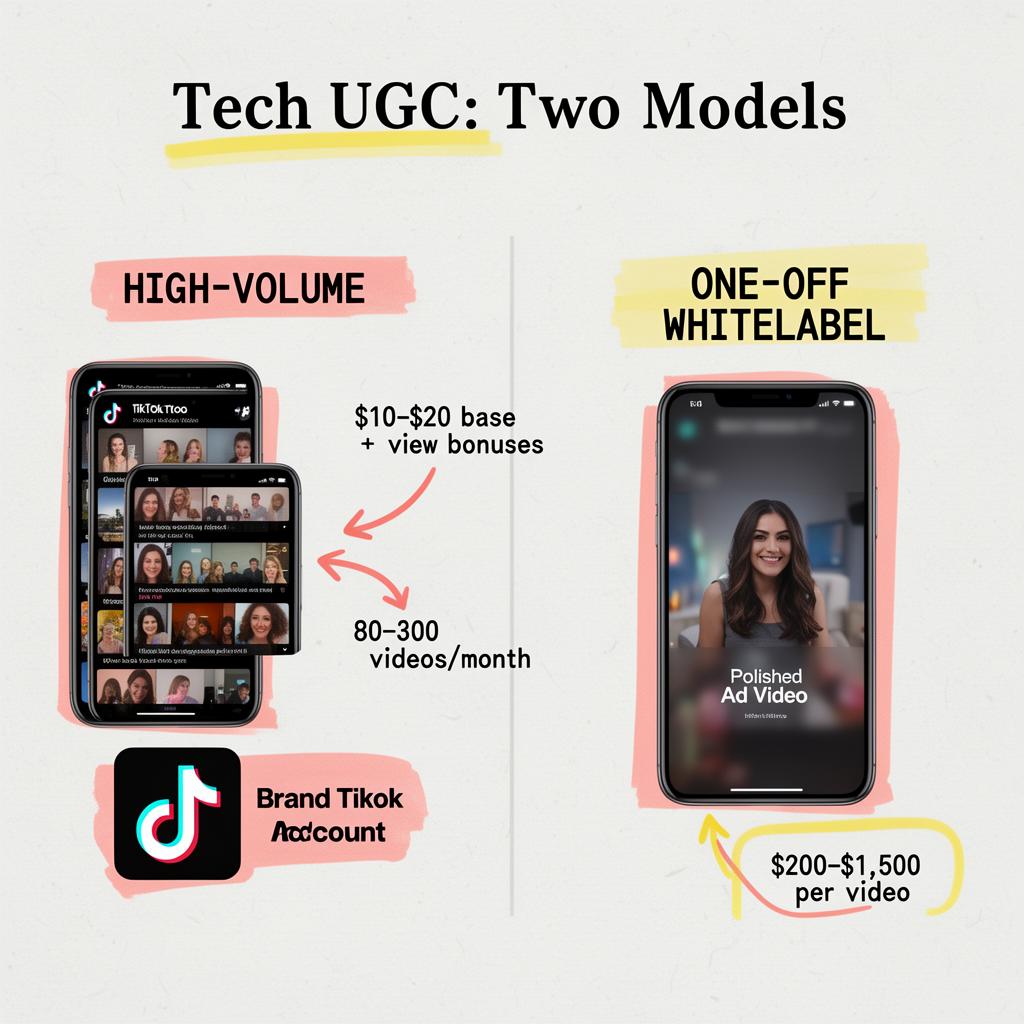
High-volume / dedicated-account model
Used by mobile-app and AI-tool studios to flood TikTok and Reels with content
- Per-video rate
- $10–$20 per video, plus performance bonuses
- Volume
- 100–300+ videos/month per brand
- Realistic earnings
- $3,000–$15,000+/mo for active creators (mostly from view-based bonuses)
- Usage rights
- Bundled — the ambassador account exists only for that brand
- Who posts it
- Creator (or studio) posts to a ambassador account on TikTok/IG
- Best fit
- Mobile apps, AI tools, consumer SaaS chasing organic reach
- A brand-new ambassador account is created that only posts about one product.
- Creator films 5–15 short videos per week against a recurring brief.
- Per-video bonuses kick in at view thresholds (10K, 100K, 1M+).
- The brand boosts winners with paid spend; losers die quietly.
- Income comes from volume + performance, not per-video premiums.
Per-video and earnings ranges are widely reported figures from 2026 creator-economy coverage; individual deals vary.
§ 3a — The shift
Why tech UGC shifted from one-off videos to systems
The old model was simple: a brand bought one polished creator video, ran it as a paid ad, and either replaced it or rebought it when fatigue hit. Each video was an asset — and each asset had to earn back its production cost on its own.
The new model is recurring production across newly created ambassador accounts on TikTok, Reels and Shorts. The output isn't a single hero video; it's a continuous stream of variations, posted to freshly created ambassador accounts that exist for one brand only.
The advantage is iteration speed. Many hooks, many formats, many creator angles, all measured within days. The teams winning at this aren't optimizing for a single viral clip — they're learning which hooks produce not only views, but installs, signups, trials, and paid conversions, and then doubling down on the patterns that move the business metric.
§ 3b — The real edge
The real edge: format libraries, not random creativity
Winning tech UGC programs maintain libraries of hooks, formats, product angles, editing patterns, comment prompts, and CTAs. Creators don't generate disconnected ideas — they produce variants of patterns the brand has already seen work.
The brand tracks which formats win, retires what doesn't, and feeds the winners back into the next round of briefs. This is iteration disguised as creativity.
It's also why software brands need real workflow, attribution, and payout infrastructure — at any meaningful scale, briefing 10–50 creators across 4 platforms with format libraries, hook variants, and bonus rules is not a job for a spreadsheet.
§ 7 — Comparison
Tech UGC vs other UGC niches
Per-video rates alone undersell the high-volume tech model — its earnings come from output × bonuses, not a fixed per-asset fee. The table separates the two tech variants so the comparison to other niches is honest.
| Niche | Per-video pay | Typical content | Difficulty | Competition |
|---|---|---|---|---|
| Tech UGC — high-volumeHighest monthly upside | $10–$20 + bonuses | Ambassador accounts created for one brand, 80–300 videos/mo, view-based bonuses | Medium — cadence and hook variation matter more than polish | Low supply of creators who can ship at the required rate |
| Tech UGC — one-off (legacy) | $200–$1,500 | Finished whitelabel videos sold to brands' paid-ads teams | Medium-high — must understand the product | Low — fewer than 5% of UGC creators are tech-fluent |
| Beauty UGC | $100–$300 | GRWMs, swatch tests, before/afters, routines | Low-medium — production know-how matters | Saturated — the most crowded UGC niche |
| Fashion UGC | $80–$250 | Try-ons, hauls, outfit-of-the-day, styling videos | Medium — wardrobe + camera presence required | Saturated, especially fast-fashion |
| Fitness & Wellness UGC | $120–$350 | Routine clips, supplement reviews, transformation stories | Medium — physique often expected | Crowded but loyal sub-niches |
| Food & CPG UGC | $100–$280 | Recipes, taste tests, ASMR, kitchen demos | Low — gear barrier is small | Very crowded |
| Pet UGC | $75–$200 | Cute moments, product demos with pets | Low — pet does most of the work | Saturated, lower budgets |
High-volume tech UGC pays low per video but stacks: 100+ videos/month + view-based bonuses routinely produce $5K–$15K+/mo, well above any one-off niche.
§ 3 — Economics
Why high-volume tech UGC pays
Software has high margins and high lifetime value, and the brands running the most aggressive growth playbooks have decided they'd rather pay creators per viewthan per video. That's the unlock: your earnings stop being capped by your hourly rate and start tracking how well your hooks travel.
Typical output observed from a single high-volume creator running a dedicated ambassador account. Ranges vary by niche and platform.
Reported by active high-volume creators, mostly from view-based bonuses on top of base fees. Directional, not guaranteed.
Bonus tiers commonly trigger at 100K, 500K and 1M+ views. Exact amounts depend on the brand's bonus terms.
Brands consistently report difficulty finding creators who can articulate a SaaS or AI product convincingly.
The economic logic, in one paragraph
A new mobile-app or AI install can be worth $20–$200 in LTV. A polished ad shoot costs $5K–$50K and produces a single creative. A high-volume tech UGC creator costs $10–$20 per short and ships 80–300 of them a month. The brand only needs one hook to clear a million views to pay back the entire content budget — which is why brands now pay creators view-based performance bonuses on top of the base rate, and why high-volume is the most attractive way for tech creators to earn in 2026.
§ 6.5 — Adoption data
Tech UGC adoption in 2026, by the numbers
Software and AI advertisers moved the bulk of their performance creative onto creator-led UGC over the last three years. Below are the KPIs we keep coming back to when we explain why tech UGC is the most efficient way to do UGC in 2026.
Share of consumer-app and SaaS marketing teams that reported running paid UGC creative as a core channel in the last 90 days.
Volume of UGC briefs explicitly mentioning a software, AI or SaaS product across major creator marketplaces, indexed to 2023 = 1.0×.
Directional sizing of paid UGC creator spend allocated specifically to software, mobile-app and AI advertisers globally.
Click-through rate on TikTok and Reels paid placements — tech UGC creative vs. traditional studio-produced ads, blended across reporting brands.
Brand adoption & global spend, 2022 → 2026
Left axis: % of SaaS/app brands running paid UGC creative. Right axis: estimated global tech UGC spend ($B).
Highest-performing tech UGC formats, 2026
Share of top 10% paid placements (by ROAS) across reporting tech advertisers, by creative format.
Cost per install: studio ads vs. tech UGC (2026 H1)
Blended CPI on iOS & Android paid social, sample of 40+ consumer-app advertisers. Tech UGC is now ~3.7× cheaper per install than equivalent studio creative.
Figures are directional estimates blended from public creator-marketplace data, self-reported brand surveys and FMD Labs benchmarks. See the Methodology section for how we calculate each KPI.
§ 5 — Path for creators
How creators break into high-volume tech UGC
High-volume tech UGC is a cadence game, not a follower game. Brands care whether you can ship a clean 30-second video every other day for six months — and whether your hooks travel. The path below is the one most working high-volume creators followed in 2026.
- 01
Pick a high-volume sub-niche
Mobile apps, consumer AI tools, productivity, finance apps — the categories that actually run dedicated TikTok/Reels accounts. Going specific lets you outrank generalists. Pick the one where you can name 10+ apps off the top of your head.
- 02
Study 5 ambassador accounts in your niche
Find the dedicated TikTok accounts (Cal AI, RIZZ, Rocket Money, dozens of YC startups). Save the top 3 videos from each. Reverse-engineer the hook formulas, on-screen text patterns, and pacing. This is the format you'll be shipping at volume.
- 03
Build a 7-video spec reel — same brand, varied hooks
Don't make 7 videos for 7 different products. Pick ONE app you actually use and make 7 distinct hook variations of the same core demo. That proves the only skill that matters in high-volume: shipping hook variants on a recurring brief without the quality dropping.
- 04
Get matched with a high-volume program
Apply to a curated tech-creator network where brands are explicitly hiring for dedicated-account programs. The application bar is your reel — quality of variations beats follower count every time.
- 05
Lock in a workflow that ships 5–15 videos/week
The job IS the cadence. Batch-film 2–3 days a week, edit in CapCut with templated captions and on-screen text, and post on the brand's schedule. Creators who survive in high-volume have a repeatable production line, not a creative process.
- 06
Track winners and double down on hooks that travel
Most of your monthly income will come from a small number of videos that clear bonus thresholds. Look at which hooks crossed 100K+ and clone the structure (not the script) ten more times. This is the loop that turns a $1.5K month into a $10K month.
A typical first week
- Day 1–2: Pick your sub-niche and find 5 ambassador accounts to study
- Day 3–5: Film 7 hook variants for one app you actually use
- Day 6: Build a one-page Notion portfolio with the reel + cadence you can commit to
- Day 7: Apply to a curated high-volume tech-creator network
Skills checklist
- Writing 10+ hook variants for the same product without recycling
- Filming clean phone-only footage in repeatable lighting
- Fast CapCut editing — captions, B-roll, zooms, on-screen text
- Reading TikTok analytics and identifying the hook that earned the views
- Sticking to a posting cadence even when individual videos flop
- Treating output as a system, not as one-off creative work
Tools worth learning
Where high-volume briefs come from
Dedicated-account programs are almost never advertised publicly. Brands run them through a small number of curated tech-creator networks, plus quiet referrals between growth marketers. The two reliable inbound paths in 2026:
- The leading high-volume marketplace
creators.viral.app is the largest marketplace for high-volume tech UGC jobs — SaaS, AI and mobile-app brands post recurring briefs with view-based bonuses, and views and payouts are tracked automatically per video.
- Repeat work and referrals
Once you're shipping reliably for one brand, growth managers in the same ecosystem will pull you into adjacent programs. High-volume is a small world.
- One-off whitelabel (legacy fallback)
LinkedIn outbound to SaaS growth leads still works for the classic per-video model, but it's a slower path with a lower ceiling than high-volume.
§ 4 — Rate ranges
What tech UGC actually pays in 2026
High-volume rates look small per video, but stack with bonuses and output. One-off whitelabel pays more per asset, but caps faster. Ranges below aggregate publicly reported 2026 creator-economy data.
High-volume — starter
- — First 1–2 months on a dedicated-account program
- — 30–60 videos/month, learning the brand's voice
- — Performance bonuses unlock at 100K+ views
- — Typical monthly take: $1,500 – $3,000
High-volume — established
Sweet spot- — Ships 80–200 videos/month across one or two brands
- — Bonus tiers: ~$50 at 100K, ~$250 at 500K, ~$750+ at 1M
- — $5,000 – $15,000+/month is normal at this level
- — No usage-rights line item — the ambassador account is dedicated to the brand
One-off whitelabel (legacy)
- — The classic UGC model, still common in B2B SaaS
- — Tech niche premium: +15–25% over generic UGC
- — Usage rights add 30–50% of base for 30 days of paid
- — Realistic ceiling: $3K – $8K/mo at intermediate tier
Premium one-off (niche expert)
- — Niche authority (AI, dev tools, fintech) + case studies
- — Direct relationships with SaaS marketing teams
- — Whitelisting available at +30–50% monthly
- — Outliers in B2B SaaS reach $2K+ for premium briefs
Where the upside actually lives
In high-volume, the base fee is just the floor. Performance bonuses (or a flat CPM) are where monthly income compounds.
Bonus structures vary by program — some pay fixed amounts at view thresholds, others pay a flat CPM. Both are toggle-able in the earnings calculator below.
§ 6 — Earnings model
What a tech UGC creator can actually earn
Most public discussion of UGC pay focuses on per-video rates and ignores the structure that drives the actual paychecks: in the high-volume model, performance bonuses tied to views routinely dwarf the base creation fee. The estimator below visualizes that incentive.
Performance bonuses
illustrative rangesSlide to set how many of your 80 monthly videos cross each view threshold.
Estimated monthly
$3,275
≈ $39,300 annualized
In high-volume programs, the base fee is essentially a floor. Real income comes from boosting the share of videos that cross 100K and 1M views — which is why creators iterate hooks aggressively.
§ 8 — Script structure
Anatomy of a high-volume tech UGC video
High-volume content lives in the 15–25 second range and follows a tight five-beat template. The job isn't to write one perfect script — it's to ship ten variants of the same skeleton and let view counts pick the winner.
- 1
Hook
0:00 – 0:02The single most-tested element in high-volume. A pattern interrupt, a contrarian claim, or a screen showing a surprising result. No logos, no intros — you have two seconds before the swipe.
- 2
Stakes
0:02 – 0:06Make the pain or the surprise concrete. "This app saved me $480 in subscriptions I forgot about." Specifics out-perform vibes.
- 3
Reveal + demo
0:06 – 0:14Cut to the screen or product. Show ONE workflow, ONE outcome — feature-dump videos die. This is the bulk of the runtime in high-volume.
- 4
Payoff
0:14 – 0:20The result the viewer came for. A number, a finished output, a face reaction. Closes the loop the hook opened.
- 5
CTA
0:20 – 0:25Soft, native, single action. "Link in bio" or "It's called [App]." Hard CTAs hurt retention on organic posts.
§ 8a — Measurement
What to track after posting
Views are the headline number. They're not the most useful one. The teams who scale high-volume tech UGC track a tight stack of metrics that map content quality to business outcomes — and creator output to creator economics.
| Metric | What it tells you | Why it matters |
|---|---|---|
| 3-second hold | Hook strength | Shows whether the opener works at all |
| Average watch time | Pacing | Shows whether the edit carries attention |
| Comments | Message resonance | Reveals objections, confusion, and desire |
| Saves / shares | Reusable value | Shows whether the idea travels beyond the feed |
| Profile clicks | Account / product interest | Shows if attention becomes intent |
| Installs / signups / trials | Business outcome | Separates viral content from useful acquisition |
| Creator output | Operational consistency | Shows whether volume is sustainable |
| Bonus-trigger rate | Creator economics | Determines who earns and who should scale |
The stack doubles as creator feedback. A creator with strong 3-second hold but weak saves needs better payoff; a creator with strong installs but low output is a candidate to scale.
§ 8b — Architecture
Account architecture for high-volume Tech UGC
A ambassador account is not a billboard. It's a product surface. The brands clearing millions of organic views per month treat each account like a focused content product with a clear promise.
Niche, promise, format family
Each account should have one clear niche, one content promise, one visual language, and one repeatable family of formats. Random unrelated formats kill account-level signal.
Vary hooks more than formats
Early on, change the opener — not the structure. You're trying to find the hook curve, not the format curve.
Warm up before scaling
New accounts engage with niche-relevant content for 1–2 weeks before heavy posting. Comments and retention are the early feedback loop, not follower count.
Expand only on signal
Add more accounts, geos, languages, or creator faces only after one account shows a repeatable winning pattern. Otherwise you're multiplying noise.
§ 10 — In the wild
Six brands running tech UGC in 2026
Most of the breakout examples in 2026 are running the high-volume model. The legacy one-off model is still alive in B2B SaaS, but the share of total creator spend has tilted decisively toward dedicated ambassador accounts.
Note: these are representative public examples of category patterns observable from each brand's social channels and ad library. We do not imply confidential data or undisclosed partnerships.
- 01
Cal AI
Consumer AI · high-volume
The play: Dedicated brand TikTok shipping dozens of POV-style videos per week, all variants of the same calorie-tracking demo.
Why it works: A single hook formula, ruthlessly varied — the textbook high-volume mobile-app playbook.
- 02
RIZZ
Consumer AI · high-volume
The play: Dedicated ambassador TikTok accounts with relentless cadence and view-based creator bonuses for posts that clear 100K+.
Why it works: Proves the model scales past novelty — same brand, same niche, hundreds of millions of views.
- 03
Rocket Money
Fintech app · high-volume
The play: Hires high-volume creators to film 'subscriptions I forgot about' and money-saved hook variants on a ambassador account.
Why it works: Concrete dollar amounts in the hook → high retention → bonus thresholds cleared regularly.
- 04
Notion
Productivity SaaS · hybrid
The play: Mixes one-off whitelabel ads with a steady drumbeat of creator-led template demos posted to its own channels.
Why it works: Demonstrates that even premium SaaS brands now treat volume as a first-class channel, not just paid one-offs.
- 05
ClickUp
B2B SaaS · one-off
The play: Heavy paid social with creator-led screen recordings and 'tools I switched to' angles — classic whitelabel.
Why it works: Direct comparison hooks against incumbents (Asana, Monday) crush on cost-per-trial in the legacy model.
- 06
Cursor / dev tools
Developer SaaS · sponsorships
The play: Sponsored screen recordings from dev YouTubers + short-form clips on X and TikTok.
Why it works: Devs trust devs — production polish actively hurts credibility in this niche.
§ 9 — Notes for brands
How software brands typically run tech UGC
By 2026, UGC had become the default creative format for most SaaS and app paid-social programs. The patterns below are widely observed in working brand-side teams.
Authenticity outperforms polish
Native-feeling UGC routinely beats high-production ads on cost-per-acquisition in SaaS paid social.
Volume of creative
You need dozens of hook variations to feed an ad account. UGC scales creative cheaper than studio shoots.
Lower CPMs on social
Algorithms reward content that doesn't look like an ad. UGC hits the For You feed at organic CPMs.
Built-in social proof
Real people demoing your product is the strongest trust signal a SaaS landing page can have.
A short brand-side checklist
- — Write briefs that are 1 page max — hook, problem, product, CTA, brand do/don'ts.
- — Always buy usage rights upfront. Without them you can't run paid.
- — Ship 3–5 hook variations per concept; only the hook matters in the first 3 seconds.
- — Test in organic first when possible, then graduate winners to paid.
- — Track creator-level CAC, not just campaign-level. Top creators are 10× better than median.
§ 9a — Operations
How brands operationalize Tech UGC
1–2 creators
Spreadsheets are fine
At small scale, a Notion or Google Sheet for briefs, a shared drive for raw footage, and a manual monthly invoice can work. Most brands start here.
10+ creators across TikTok, Reels, Shorts, Facebook
The hard part stops being creative
It becomes briefs, account access, posting schedules, view tracking across platforms, performance attribution, bonus-tier calculations, payout rules, and creator-level performance reporting. Spreadsheets break here.
In practice
- Brand side: viral.app is the system of record for briefs, creator management, view tracking, attribution and performance-based payouts in high-volume UGC programs.
- Creator side: creators.viral.app is the marketplace where creators apply to high-volume Tech UGC briefs from SaaS, app and AI brands and get paid through automated bonus tracking.
§ 11 — Common pitfalls
Six mistakes that kill high-volume tech UGC earnings
Treating high-volume like one-offs
Polishing each video for two days kills the model. The job is shipping cadence — 5–15 posts a week — not a single perfect asset.
No hook variation
Posting the same hook ten times tells the algorithm nothing. You're paid (in bonuses) when one variant breaks out — variants are the product.
Demoing every feature
Pick one workflow, one outcome. Feature-dump videos lose retention before the demo even lands and never clear bonus thresholds.
Wrong aspect ratio or duration
9:16 native, 15–25 seconds. Anything longer bleeds retention; landscape footage gets cropped badly and underperforms.
Ignoring captions and on-screen text
85% of social video is watched on mute. Burn captions in and use bold on-screen text for the hook — it's where most high-volume views are won or lost.
Not tracking which hooks earn the bonuses
Most of your income comes from a small handful of videos. If you can't tell which hook crossed 100K+, you can't clone it — and the next month looks like the last.
§ 12 — AI avatars vs human creators
Will AI avatars replace tech UGC creators?
Short answer: no, but the work is shifting. AI is absorbing the bottom of the market — generic talking-head reads — while pushing premium tech creators toward higher-trust, demo-heavy work that current models still cannot fake convincingly.
| Factor | AI avatars (HeyGen, Captions, Arcads) | Human creators | Edge |
|---|---|---|---|
| Cost per video | $1–$10 | $10–$500 | AI |
| Speed to produce | Minutes | 1–5 days | AI |
| Authenticity perception | Low — uncanny ceiling | High — that's the point | Human |
| Believable product use | Weak — can't actually use software | Strong — real workflows | Human |
| A/B testing hooks | Excellent for variation at scale | Slow but higher-quality variants | AI |
| Trust on B2B platforms | Falling fast as detection improves | Still the gold standard | Human |
| Creative range | Limited to training distribution | Bounded only by creator skill | Human |
The takeaway for creators
Lean into what AI can't do: actually using the product, riffing in your own voice, and building genuine relationships with brand teams. Use AI for the parts that are tedious — hook variations, B-roll, captions — not for the part the brand is paying you for.
§ 13 — FAQ
Frequently asked questions
§ 14 — Methodology
Methodology and rate caveats
This guide synthesizes public creator-economy patterns, observed high-volume UGC campaign structures, creator marketplace workflows, and software/app growth examples. Rate ranges are directional. Actual payouts depend on niche, brand budget, platform, geography, view quality, conversion quality, usage rights, and bonus terms.
Where we describe specific brands (e.g. in § 10 — In the wild), we are describing publicly observable patterns from their content channels and ad libraries. We do not imply confidential information, undisclosed partnerships, or insider data. Examples are representative of category behavior, not endorsements.
tech-ugc.com is an editorial guide produced by the team behind viral.app, the brand-side operating system for high-volume UGC, and creators.viral.app, the creator-side marketplace. Our perspective is shaped by direct exposure to live high-volume tech UGC programs.